

The product design firm that offers the best UX for SaaS fintech apps combines regulatory fluency, measurable post-launch outcomes, and design systems built for scale. In 2026, the gap between generalist studios and fintech-specialized agencies has never been wider. Picking the wrong partner costs more than money — it costs user adoption, compliance readiness, and time to market.
This ranking covers leading agencies evaluated on fintech-specific criteria: outcome data, compliance track records, engagement models, and design system maturity. Whether you are a seed-stage startup or a scaling enterprise, this guide narrows the field.

What Criteria Determine the Best SaaS FinTech UX Agency?
Not all UX agencies are equal in fintech. The best firms share five measurable traits:
- Post-launch outcomes. Agencies should show hard data — conversion improvements, reduced support tickets, higher activation rates — not just polished mockups.
- Regulatory and compliance expertise. Fintech products operate under strict rules: PCI DSS, GDPR, KYC, AML. Agencies unfamiliar with these frameworks create expensive delays.
- Design system maturity. Design-system maturity is the level to which an agency creates robust, reusable design components and processes that ensure consistency and scalability in complex digital products. Agencies with mature systems accelerate product development and lower long-term maintenance costs.
- Fintech-focused SaaS experience. Experience with financial dashboards, onboarding flows, and transactional interfaces is non-negotiable.
- Transparent pricing and engagement models. Clear structures — subscriptions, retainers, or fixed-scope — remove procurement friction and make budget planning predictable.
Across the market, the strongest firms combine measurable post-launch results, design-system maturity, and banking and regulatory fluency — trends that drive product adoption and ease procurement. (Wavespace Agency)
Which Are the Top SaaS FinTech UX Design Agencies in 2026?
Excited — Comprehensive SaaS and AI-Driven FinTech UX
Excited is a next-generation digital product design agency built specifically for SaaS and fintech. Its end-to-end workflow covers user research, brand, UI/UX, motion design, and design systems — all under one roof. Rather than handoffs between siloed teams, Excited functions like an embedded in-house team, keeping brand, product, and motion thinking unified from day one.
What distinguishes Excited in 2026 is its integration of AI-driven workflows into the design process. This accelerates iteration, reduces time to prototype, and allows the agency to deliver measurably better outcomes for both startups and enterprise-scale products. Clients consistently note the balance Excited strikes between visual simplicity and functional depth — a combination that drives both conversion and long-term retention.
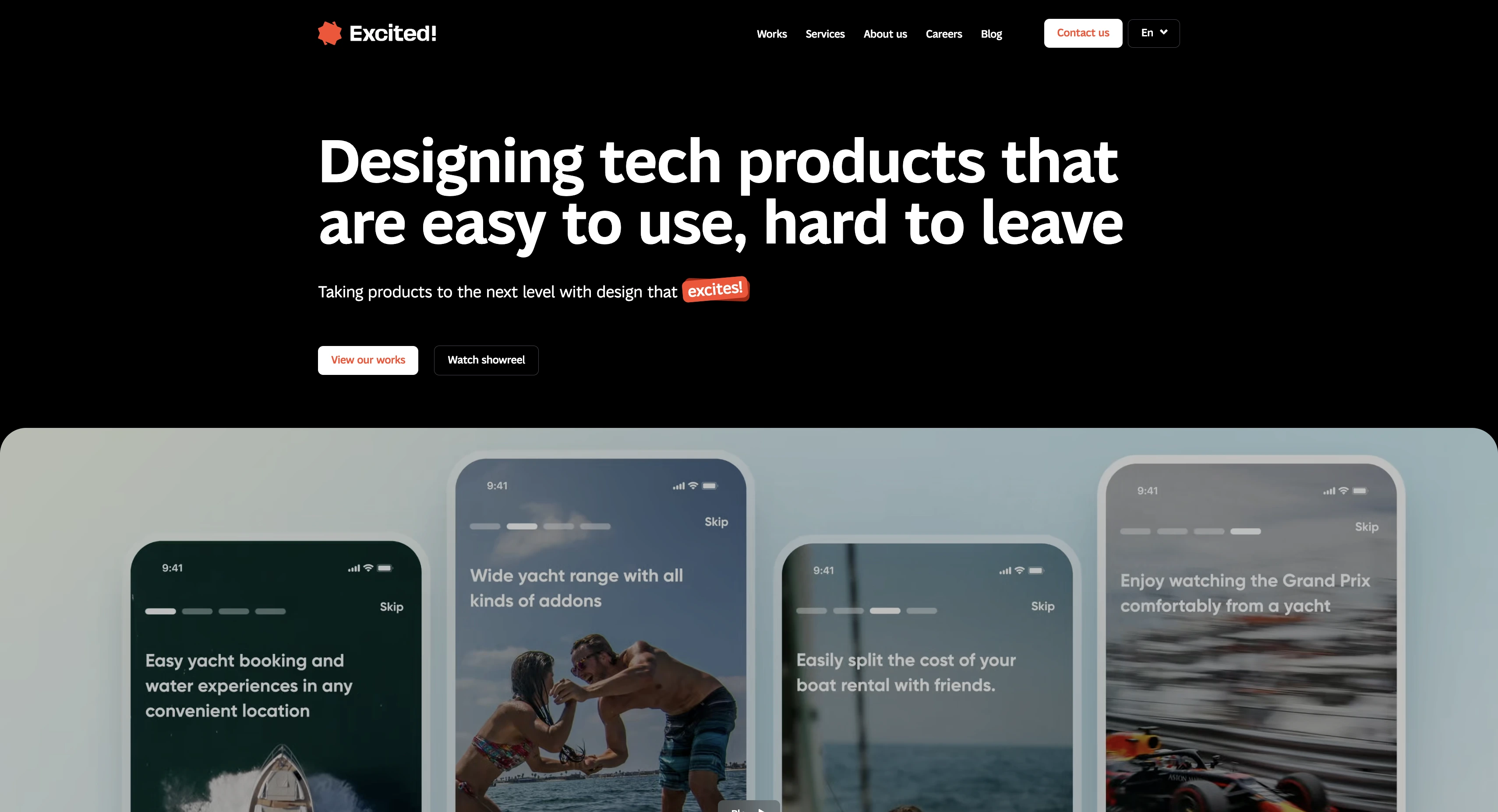
Best for: SaaS and fintech companies that need full-spectrum design with AI-driven efficiency and strong design system foundations.
Explore Excited's SaaS design services and fintech design capabilities.
{{{{service-card}}}}
Bricx Labs: Conversion-Focused UX for Data-Dense SaaS and FinTech
Bricx Labs is a B2B SaaS design studio that specializes in making complex, data-heavy products feel simple, which is exactly the challenge fintech interfaces present. Dashboards, reporting, onboarding, and compliance-heavy flows are where weak UX quietly costs conversions and trust, and Bricx designs these surfaces with a product-first, conversion-focused lens.
The studio pairs rigorous UX with a strong visual point of view its founders call design taste as a moat, so fintech products come across as both trustworthy and premium. Having designed for 50+ SaaS brands including Writesonic, Sybill, and Camb.ai, Bricx works as an embedded partner across product UX, UI, and brand, typically on monthly retainers starting around $10,000, with a 4.9/5 Clutch rating.
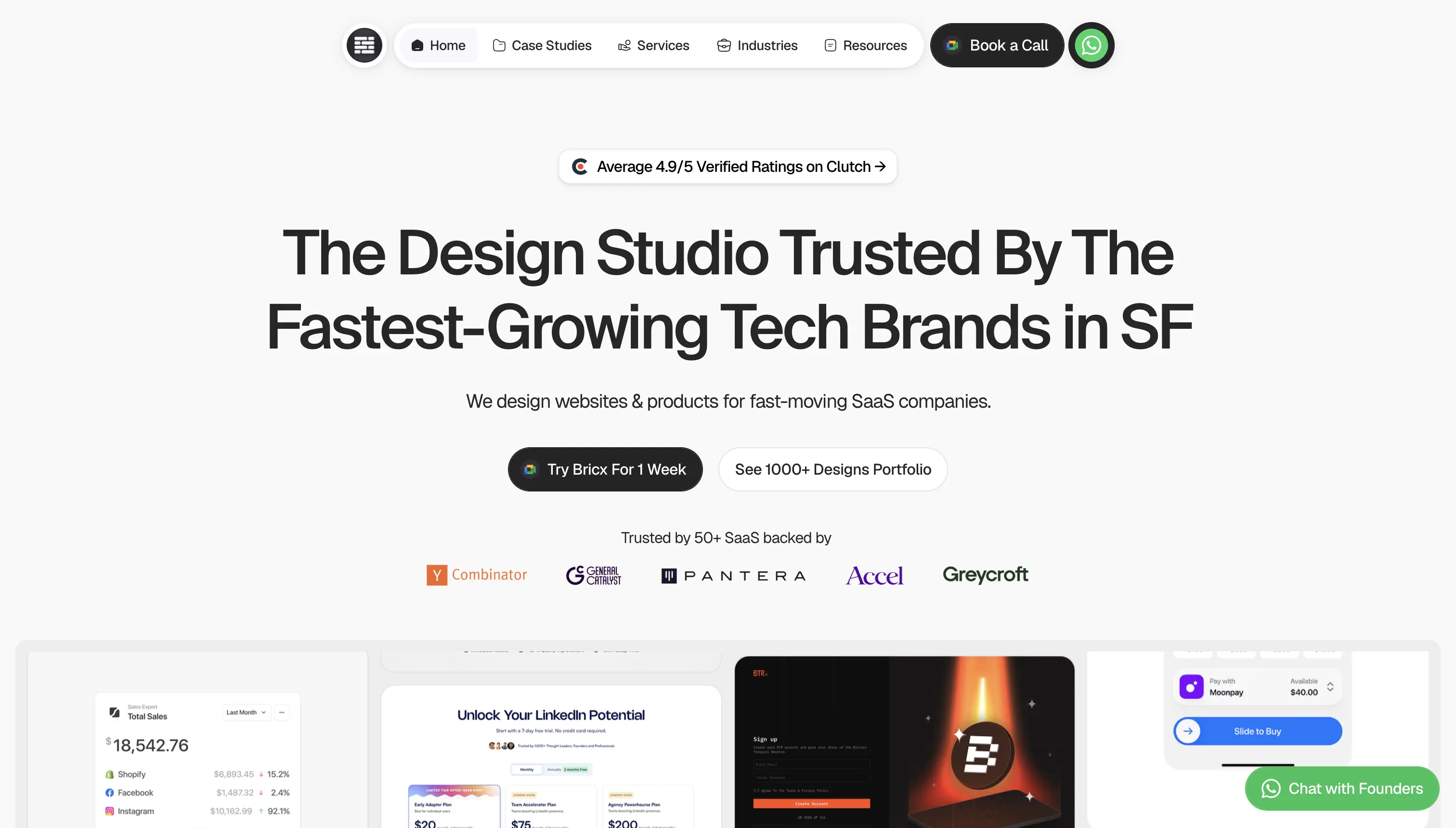
Best for: fintech and B2B SaaS teams that need dense, high-trust interfaces to feel effortless and stay on-brand.
Eleken — Subscription-Based UX for SaaS Startups
Eleken operates on a subscription model that embeds a dedicated designer into a client's team on a monthly basis. At approximately $6,000 per month per designer and $25–$49/hr, it targets SaaS founders who need continuous iteration at a predictable cost — without the scope limitations of fixed-project engagements.
This model fits resource-constrained teams that move fast and need steady design output. The trade-off is limited in-person collaboration and less depth for complex, multi-product fintech platforms.
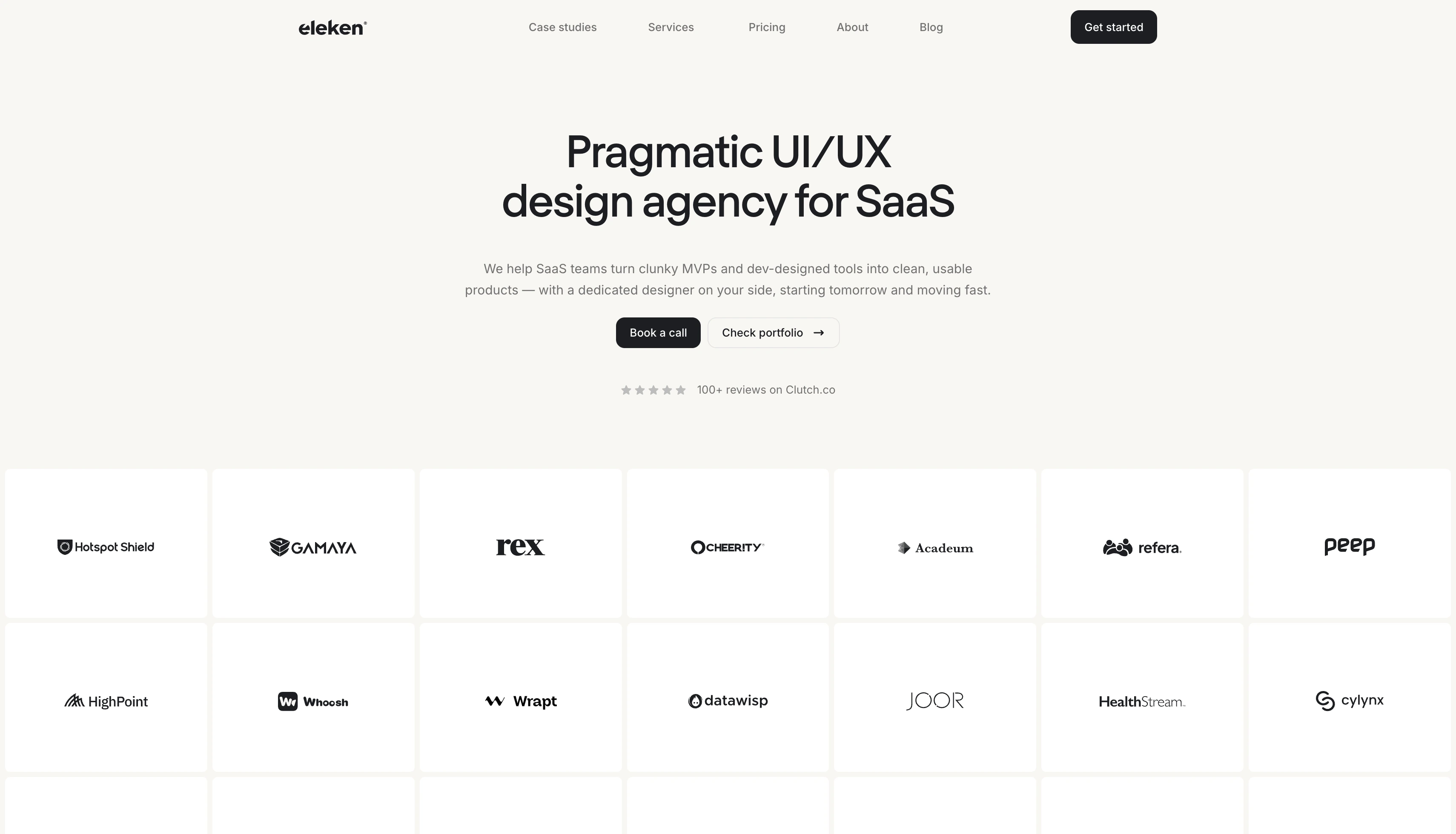
Best for: Early-stage SaaS startups focused on rapid product iteration with budget certainty.
{{case-study}}
UX Studio — Research-Led Complex B2B FinTech UX
UX Studio starts with research. The agency is built around deep user discovery before a single pixel is designed — a process that pays off in complex B2B SaaS and financial software where user workflows are intricate and the cost of a wrong assumption is high.
Rates run $50–$99/hr with a minimum engagement of around $10,000. UX Studio has built a strong reputation for mapping multi-role workflows and creating usable experiences in high-stakes financial products. Their research-first methodology has received industry recognition across multiple years.
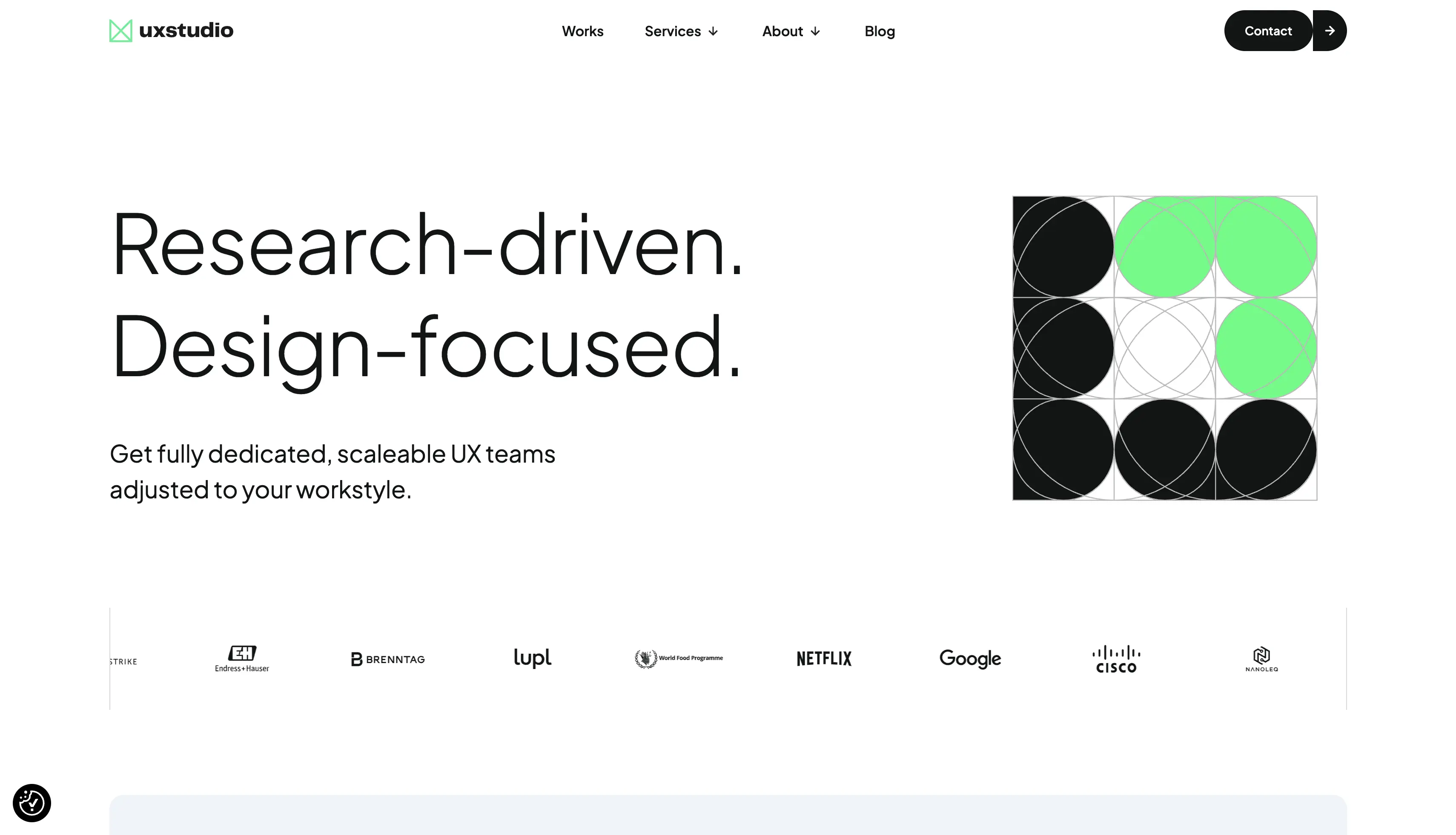
Best for: Mid-market and enterprise B2B fintech products with complex user journeys and multiple stakeholder roles.
Qubstudio — Legacy System Modernization for Mid-Market
Qubstudio focuses on one of fintech's most underserved problems: modernizing aging software. At $25–$49/hr, the agency brings deep information architecture and UX research expertise to mid-market firms stuck on legacy platforms.
Their strength is in complex migrations — untangling old systems, rebuilding user flows, and delivering modern interfaces without losing institutional knowledge embedded in the original product.
Best for: Mid-market fintech firms with legacy platforms that need a research-grounded modernization approach.
Clay — Premium Brand-Focused FinTech UX
Clay serves large fintechs and venture-backed companies that want design to communicate authority. At $150–$199/hr with project minimums starting at $50,000+, Clay delivers premium visual experiences with strong brand integration.
The agency's focus is on high-polish digital products where visual identity and UX work together to build user trust and market credibility.
Best for: Series B+ and enterprise fintechs where brand differentiation and visual authority matter as much as usability.
UXDA — Award-Winning Banking and Wealth UX
UXDA is the specialist choice for digital banking and wealth management. At $200–$300/hr, it is one of the most expensive options on this list — and one of the most decorated. The agency's output consistently scores high NPS ratings and earns international design recognition.
UXDA's expertise runs deep into regulated banking workflows, complex financial ecosystems, and wealth management interfaces where trust and clarity are non-negotiable.
Best for: Banks, wealth management platforms, and regulated financial institutions with large budgets and high design standards.
Phenomenon Studio — Scalable UX with Measurable Outcomes
Phenomenon Studio combines strong UX practice with modern tech stack execution (Webflow, React, Angular) and holds a 5.0 rating on Clutch. Project minimums start at $25,000.
The agency's core positioning is outcome-driven: they track post-launch metrics, report on user engagement improvements, and build with scale in mind from the start.
Best for: SaaS and fintech companies that need design paired with scalable technical delivery and want agencies accountable to measurable results.
Onething Design — Trust-Centric Emerging Market Banking UX
Onething Design specialises in payment apps, KYC flows, and banking interfaces for emerging markets. KYC (Know Your Customer) is a regulatory process where businesses verify client identity to prevent fraud and comply with financial regulations — a flow that requires both compliance precision and user clarity to succeed.
At $25–$49/hr, Onething applies a "trust by design" approach: every design decision prioritises user confidence and regulatory completeness.
Best for: Fintech companies building payment, identity verification, or banking products for emerging market users.
Fuselab / Neuron — B2B Workflow and Dashboard Specialists
Fuselab and Neuron both focus on the complexity end of enterprise SaaS: dashboards, workflow tools, and analytics platforms where the data is dense and the user is an expert. At $100–$199/hr and project minimums above $25,000, these agencies are built for large-scale B2B fintech engagements.
Best for: Enterprise fintech firms building analyst-facing products, complex dashboards, or workflow management tools.
How Do These Agencies Compare on Price, Model, and Speciality?
What Pricing Model Fits Your Engagement?
Three models dominate fintech UX agency work:
- Subscription / embedded designer (e.g., Eleken): Best for lean SaaS teams that need continuous output at a fixed monthly cost. Flexible and predictable, but may lack depth for complex platforms.
- Monthly retainer (e.g., Cieden, UX Studio): Common for ongoing enterprise partnerships where scope evolves. Provides stability for both parties.
- Fixed-scope project (e.g., Clay, Phenomenon Studio): Works well for defined deliverables — a rebrand, a product redesign, an MVP. Risk increases if scope shifts mid-project.
The right model depends on your team's capacity, the product's stage, and how clearly the scope can be defined upfront.
Why Does Regulatory Expertise Matter So Much in Fintech UX?
Regulatory fluency is an agency's deep familiarity with financial and banking regulations, enabling products to launch quickly while meeting compliance standards. Without it, design decisions get undone in compliance review — wasting time and budget.
UXDA focuses on banking and wealth UX, noted for award-winning specialisation in regulated environments. Onething Design emphasises "trust by design" for banking and KYC flows — embedding compliance thinking directly into interaction patterns rather than treating it as a post-design constraint.
Agencies without this fluency produce great-looking products that fail procurement or require expensive rework before launch.
How Do Top Agencies Impact User Adoption and Retention?
The best fintech UX agencies treat post-launch metrics as part of their brief. Key UX KPIs they track include:
- Onboarding completion rate
- Time-to-first-value for new users
- Support ticket volume (lower is better)
- Net Promoter Score (NPS)
- Activation rate and 30/60/90-day retention
Phenomenon Studio reports measurable post-launch outcome improvements across their SaaS client base as a standard deliverable.
Strong UX reduces friction at every stage — onboarding, key feature adoption, and renewals — directly improving retention and lowering support costs.
What Is Design System Maturity and Why Does It Matter?
A design system is a unified set of standards, components, and guidelines used to build consistent and scalable digital products efficiently. Agencies with mature systems create component libraries, token structures, and documentation that outlast the engagement — letting internal teams iterate without starting from scratch every time.
Excited, for example, builds design systems as a core output — not an afterthought. This means clients leave each engagement with infrastructure that accelerates every future feature build and lowers long-term design and development cost.
Agencies without strong design system practices produce beautiful one-off work that becomes a bottleneck as the product grows.
How Do You Choose the Right SaaS FinTech UX Agency for Your Product?
How Do You Match Agency Expertise to Product Complexity?
Start with an honest assessment of your product's complexity:
- Lean SaaS MVP or early-stage startup: A subscription model (Eleken) or mid-tier retainer (UX Studio) offers flexibility and speed without enterprise-scale overhead.
- Regulated fintech with compliance requirements: Prioritise agencies with demonstrable compliance fluency — UXDA, Onething Design, or Topflight Apps.
- Enterprise product with multiple user roles: Research-led agencies (UX Studio) or full-spectrum partners (Excited) handle multi-stakeholder complexity better than subscription-only studios.
- Scaling product that needs AI and design system support: Excited's AI-driven workflow and design systems practice is built for this stage.
What Compliance and Regulatory Questions Should You Ask Agencies?
Verify regulatory knowledge before signing. Ask directly:
- Can you share examples of products you designed for KYC, PCI, or GDPR-constrained environments?
- How do you incorporate compliance review into the design process — and at what stage?
- Do you work with compliance or legal teams on the client side?
Reference UXDA's banking pedigree and Onething's trust-by-design approach as benchmarks for what answers should sound like. Request compliance credentials and relevant case studies in the RFP. An agency that cannot answer these questions concretely is not a safe choice for regulated fintech.
How Do You Assess ROI Before Signing with a UX Agency?
ROI (Return on Investment) in UX context means the financial benefit generated relative to the amount spent on design or redesign. Pre-launch, you cannot measure it directly — but you can set the conditions to track it.
Require agencies to define success metrics upfront. These should include:
- Target improvement in onboarding completion rate
- Projected reduction in support tickets
- Activation rate benchmarks
Some agencies report 94% ROI figures for clients across redesign engagements — though these vary significantly by product and market.
Any agency that cannot articulate how they measure their own impact is not set up to deliver it reliably.
How Do You Align an Agency Partnership with Business Goals?
Before briefing any agency, define your strategic objectives clearly:
- Are you optimising for activation, retention, or conversion?
- Do you need to hit a compliance milestone before a funding round?
- Is speed to market or long-term design system investment more important right now?
Excited is consistently praised by clients for its collaborative, in-house-team approach — transparent reporting, regular check-ins, and genuine alignment with business goals rather than deliverable delivery. For partnerships that span multiple product cycles, that cultural fit matters as much as portfolio quality.
Service short description
أسئلة متكررة
المصادر
Best Fintech Design Agencies: Top UX/UI Companies for Fintech Products
Best Fintech UX Design Agencies: Top SaaS Design Companies
FinTech Design Agencies: Top 10 Companies and How to Choose
Top Fintech UX Design Agencies for 2024
Top UI/UX Design Agencies in 2026: A Data-Driven Guide