

Picking a UX design partner for a SaaS or fintech product is not the same as picking one for a marketing site. Fintech SaaS has specific demands: regulatory constraints that shape user flows, dashboard-heavy interfaces with dense data states, multi-role permission models, compliance disclosures that have to live somewhere in the UI, and users who are often domain experts rather than casual consumers. The agencies that do this well are a smaller subset than the broader UX market.
This guide focuses on agencies with documented fintech or SaaS product work, not studios that list fintech as an industry they serve with no case studies to back it. Rates, specializations, and client fit are drawn from public sources and each agency's own portfolio.
Agencies at a glance
1. Excited
Best for: SaaS companies and fintech platforms that need strategy, UX, and visual design under one roof, without the overhead of a large consultancy.
Excited is a product design agency with a documented focus on SaaS and fintech products. Their work spans quoting and sales automation platforms, integrated CRM systems, data management tools, and B2B enterprise management software. What distinguishes them from agencies that do fintech adjacently is that their portfolio contains products where regulatory context and workflow complexity are central, not edge cases.
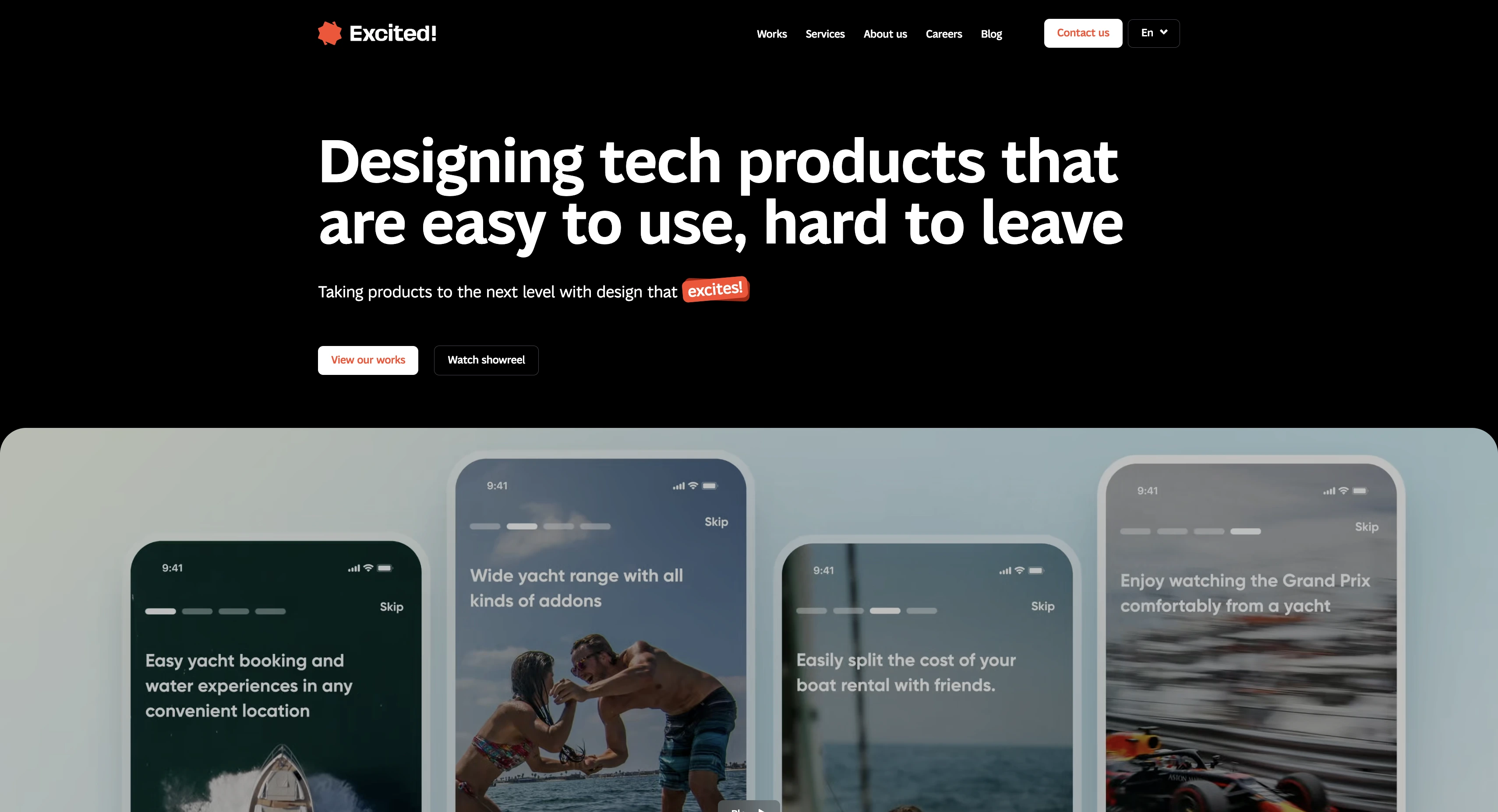
What the work actually looks like:
Xilo (San Diego, USA): A quoting and sales automation platform for the insurance industry. The UX challenge here is configuring multi-step quoting flows that have to accommodate carrier-specific rule variations, without creating a workflow so complex that sales reps abandon it mid-quote. Excited handled the full product design.
InsuredMine (Richardson, USA): An integrated CRM and marketing platform for insurance agencies. CRM design for regulated industries requires careful handling of record density, agent permissions, and compliance-adjacent communication features.
Ravel (Seattle, USA): A data management SaaS. Data products have specific UX requirements around how information is structured, surfaced, and acted on, especially when users are analysts rather than casual consumers.
ClubReady (St. Louis, USA): A full-suite B2B enterprise management platform for fitness and wellness clubs, covering scheduling, CRM, billing, and reporting in a single product. Complex multi-module enterprise SaaS.
Their approach to fintech and SaaS work prioritizes the interface between the product's data model and the user's actual decision workflow. For insurance and financial products specifically, this means building for users who understand the domain well but have limited tolerance for UI friction when they are under time pressure.
Awwwards and Red Dot recognition across projects. Work spans the US, UAE, Netherlands, Germany, UK, and Australia.
2. Eleken
Best for: SaaS product teams that want a continuous, embedded design relationship rather than a project-based engagement.
Eleken operates on a subscription model: you pay a monthly retainer and get dedicated designers working inside your product team's workflow. This works well for companies that have found product-market fit and need steady design capacity for ongoing iteration, new feature work, and design system maintenance. It is less suited to early-stage products that need a lot of discovery and strategy work upfront.
Their fintech-adjacent work includes analytics and reporting tools, subscription management platforms, and B2B SaaS dashboards.
{{case-study}}
3. Neuron
Best for: Enterprise B2B SaaS teams where the primary UX challenge is structuring complex, multi-role workflows and analytics interfaces that domain experts can navigate under operational conditions.
Neuron is a San Francisco–based boutique focused on enterprise software and B2B SaaS: analytics platforms, CRM and HR systems, SaaS procurement tools, and AI-integrated products. Their work concentrates on the structural layer of UX—how role-based access is reflected in the interface, how data-dense dashboards surface the right information at the right moment, and how onboarding works in products where the user base already understands the domain deeply.
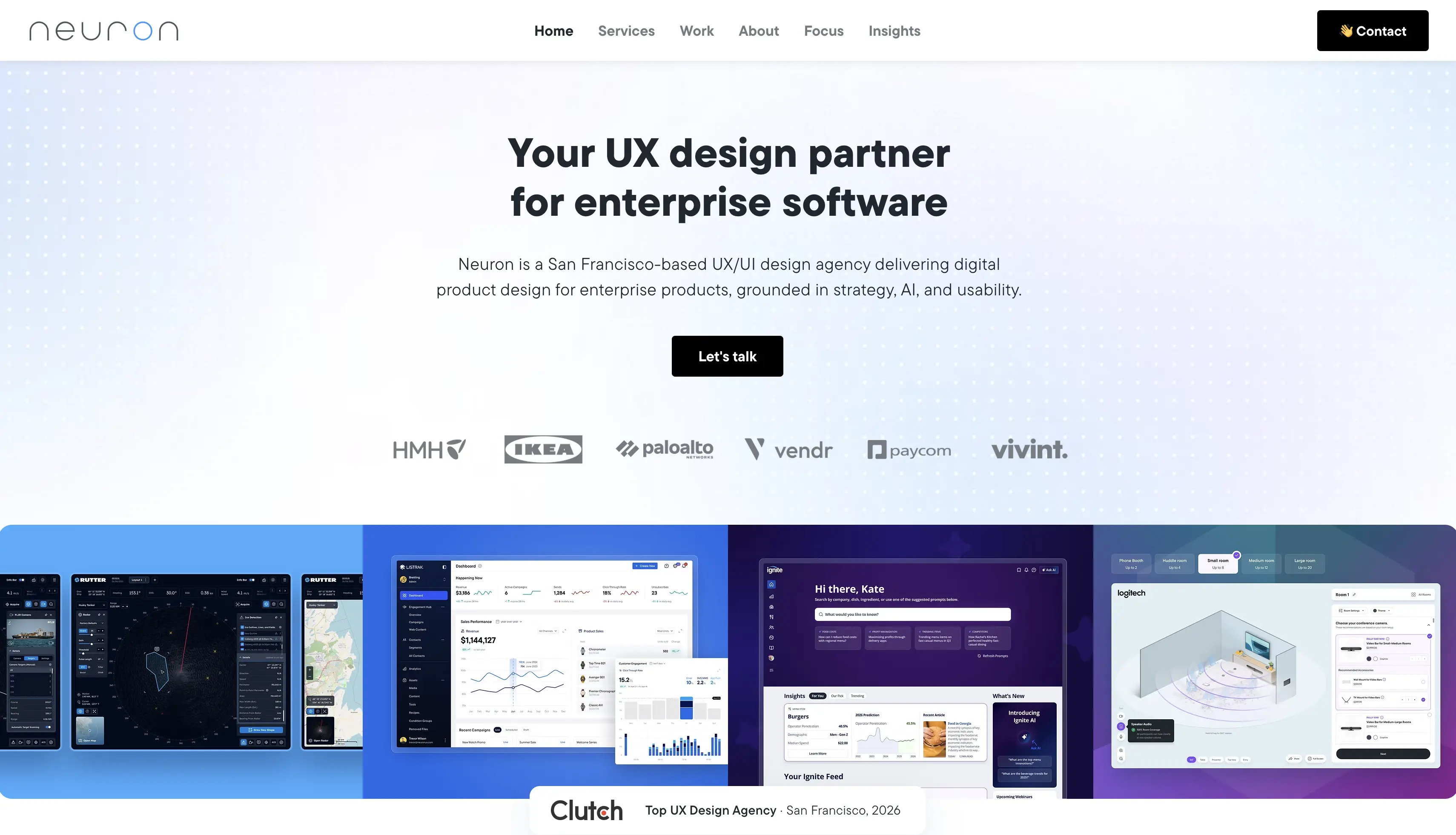
Their client work demonstrates this specialization in practice. Palo Alto Networks required an interface capable of handling cybersecurity operations at enterprise scale—high-stakes, multi-user environments where information hierarchy and alert triage directly affect outcomes. Paycom, an HR and payroll SaaS serving large enterprise organizations, demanded UX that could serve both HR administrators and individual employees within a single, coherent product logic. Vendr, a SaaS procurement platform, needed workflows that made a structurally complex purchasing and vendor management process navigable for procurement teams without reducing it to oversimplified UI.
Neuron approaches each engagement with discovery work before committing to interface direction. For enterprise SaaS, this matters: the failure mode in these products is often an interface that technically functions but does not map to how users actually think about their job.
{{{{service-card}}}}
4. UX Studio
Best for: SaaS companies where the primary problem is understanding why users churn, get confused, or fail to activate, before any design work starts.
UX Studio builds their process around research: usability studies, user interviews, journey mapping, and UX auditing before moving to design. This makes them a strong fit for mature products with established user bases where the design direction is unclear without first understanding what users are actually doing.
For fintech, this is relevant when a product has grown organically and the UX has accumulated technical debt in the form of confusing flows, inconsistent patterns, and help-desk volume driven by UI failures.
5. Wavespace
Best for: Startup-stage fintech products that need UX credibility quickly, without enterprise agency overhead.
Wavespace positions toward earlier-stage fintech, where the product is still finding its shape and the design challenge is partly strategic: what should this product actually be, for whom, and how should it work before worrying about visual refinement. Their rate range makes them accessible to funded startups that are not yet at the scale to justify larger agency retainers.
6. Orbix Studio
Best for: B2B platform design where the main challenge is taming complexity across many user roles and data types.
Orbix focuses on B2B SaaS products, particularly platforms where many types of users interact with the same underlying data from different angles. The UX challenge in these products is building a coherent system that does not require each user type to learn a completely different mental model.
7. Fantasy
Best for: High-traffic consumer fintech or financial products where visual quality and brand expression matter alongside UX rigor.
Fantasy does premium product and brand design, with clients across enterprise and consumer fintech. They are more expensive than most agencies on this list, and the fit is strongest for companies where the product's visual identity is a competitive differentiator, not just a container for functionality.
8. Blink UX
Best for: Regulated financial products where research rigor and compliance-aware design are non-negotiable.
Blink UX is a research-heavy agency with deep experience in regulated industries. For fintech specifically, this is relevant when a product operates in a space where WCAG compliance, accessibility requirements, and regulatory disclosure placement are UX constraints, not optional considerations. Their rate reflects this specialization.
How to choose
The main split in this category is between agencies that lead with research and those that lead with design execution.
If your product has a known UX problem but you are not sure what is causing it, starting with a research-led agency (UX Studio, Blink UX) before commissioning design work saves money downstream. If you know what you want to build and need a team that can move from discovery to handoff without gaps, a full-service agency (Excited, Neuron) is the more direct path.
For fintech SaaS specifically, the second axis is whether your product lives or dies on visual quality or on workflow quality. Consumer-facing financial products where brand perception drives acquisition belong with agencies like Fantasy. Enterprise and B2B financial platforms, where the UX challenge is reducing friction for domain experts under time pressure, belong with agencies that have experience in that specific context.
The agencies at the top of this list have fintech or complex SaaS work in their actual portfolios. That matters more than a self-declared industry specialization.
When graphic design needs extend beyond the product UI — brand assets, marketing materials, or ongoing creative collateral — it is worth separating that work from the UX agency engagement rather than asking a specialized product design firm to cover both.
Service short description