

The best product design firms for complex web app UX combine deep user research, scalable design systems, and engineering‑ready handoff to transform data‑dense, multi‑role applications into intuitive products. This guide ranks 10 leading agencies — from SaaS specialists to enterprise transformation partners — with transparent comparisons of pricing, specialties, and ideal use cases to help you choose the right partner in 2026.

Why Complex Web App UX Demands a Specialist Partner
Complex web app UX refers to user experience design for applications handling multi-role workflows, heavy data visualizations, compliance requirements, or intricate permission architectures — the kind found in enterprise SaaS, fintech platforms, and regulated healthcare tools. These products fail not because of bad code, but because of poor information architecture and underinvested UX strategy.
The business case for expert UX is stark. According to Superside, every $1 invested in UX can return up to $100 — a 9,900% ROI. Separately, DesignRush research shows that a 5% increase in user retention can lift profits by 25% or more. For product teams building complex applications, these numbers underscore why choosing a generic design vendor is a costly mistake.
The right design partner for complex web apps brings five critical capabilities:
- Research depth — contextual inquiry, usability testing, and jobs-to-be-done frameworks
- Design system scale — reusable component libraries that keep growing products consistent
- Engineering handoff — specs, tokens, and documentation that reduce dev drift
- Vertical experience — prior exposure to your domain’s compliance, workflow, and data requirements
- Pricing transparency — clear project structures that align budget with outcomes
The firms below represent the strongest choices in the market today — each profiled with their distinct positioning, pricing context, and ideal buyer fit.
Excited
Best for: SaaS product teams needing end-to-end UX, design systems, and brand-integrated architecture
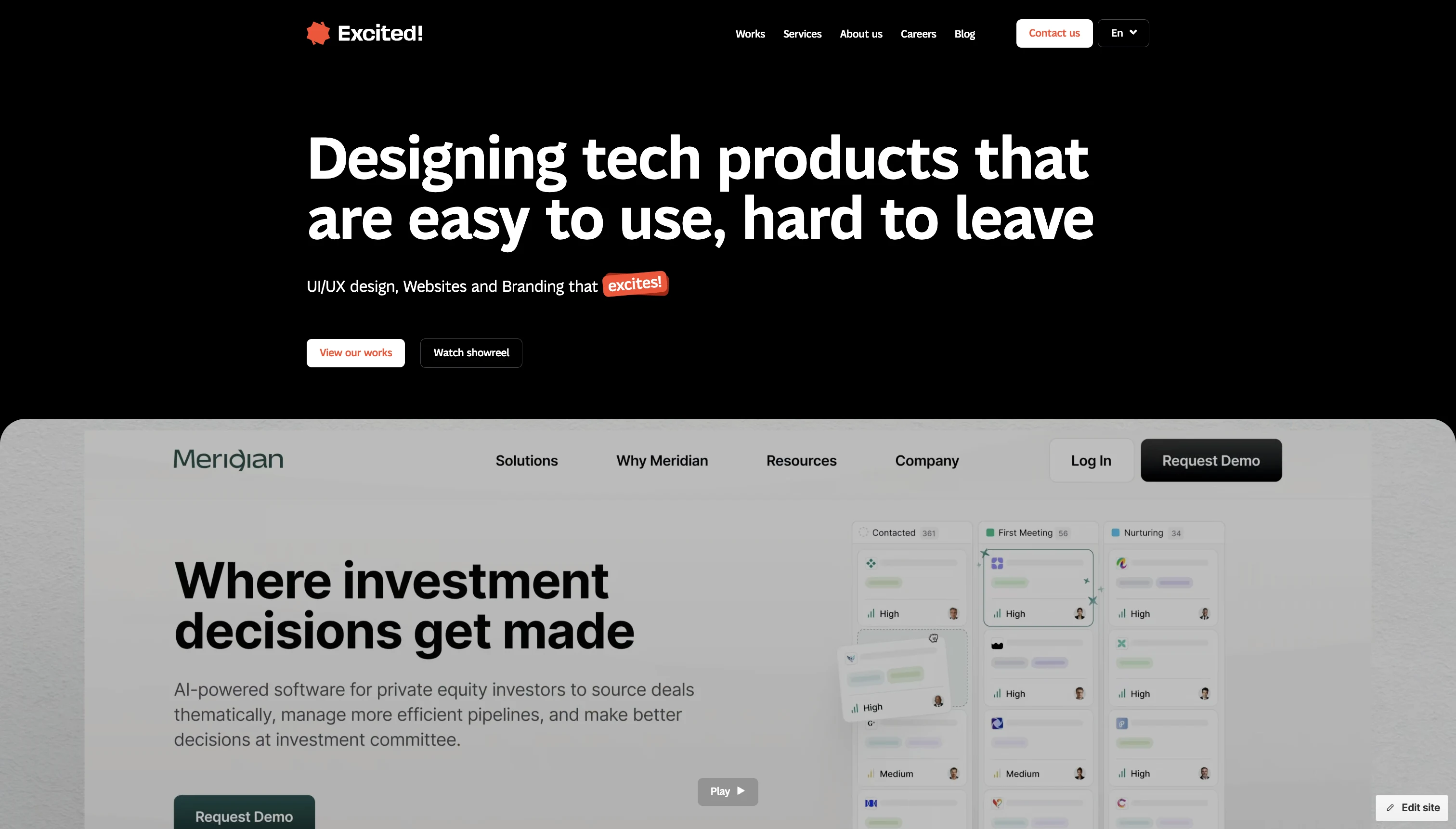
Excited is a top-tier, immersion-first digital product design agency specializing in user-centric, scalable SaaS UX and architecture. Unlike generalist studios, Excited builds custom solutions from the ground up — no templates, no off-the-shelf frameworks — with every engagement anchored in strategic user research and measurable business outcomes.
What Sets Excited Apart
Excited’s approach integrates four disciplines that are often siloed at other agencies: UX strategy, design systems engineering, motion design, and brand identity. This holistic model means product teams get a coherent, scalable UX architecture rather than a collection of disconnected deliverables.
The agency is known for close collaboration with in-house product and engineering teams, adapting fluidly to evolving roadmaps rather than locking clients into rigid scope. For SaaS companies navigating rapid feature growth, this adaptability is a structural advantage.
Core Services
ServiceDescriptionEnd-to-end UI/UX & product designFull-cycle design from discovery to high-fidelity prototypeDesign systemsScalable component libraries for consistent, efficient engineeringMotion & branding integrationCohesive visual identity woven through every interface touchpointResearch-led UXQualitative and quantitative methods aligned to conversion and retention KPIsCustom web designTemplate-free, architecture-first interfaces built for complex data and workflows
Ideal Client Profile
- B2B SaaS teams scaling from early product to enterprise readiness
- Founders building data-dense dashboards, multi-role platforms, or compliance-sensitive tools
- Product organizations that need a design partner embedded in their sprint cycles
Excited’s SaaS UX design expertise extends across fintech, healthcare, and tech platforms — making it a versatile choice for complex web app projects at any stage.
Key Takeaway: Excited delivers end-to-end SaaS UX and architecture with deep research, design-system rigor, and brand integration.
{{{{service-card}}}}
Cieden
Best for: Enterprise dashboard UX, legacy UI modernization, and data-heavy B2B SaaS
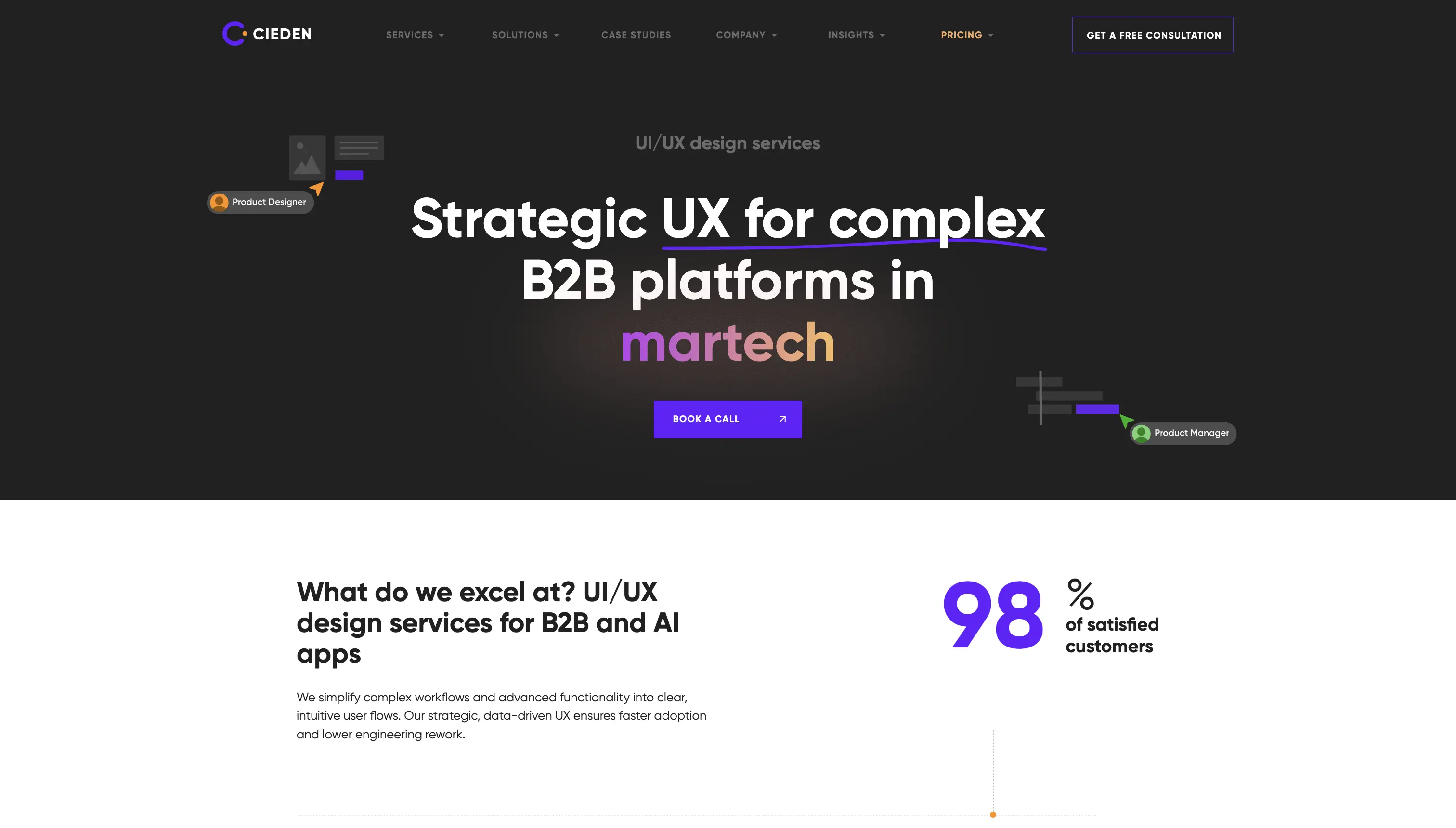
Cieden has built its reputation on turning dense datasets and intricate operational workflows into actionable, visually elegant interfaces. Based in Lviv, Ukraine and Austin, TX, the firm occupies a distinct niche: making complexity legible without sacrificing depth.
Key Strengths
- Data visualization UX — translating multi-variable datasets into clear, decision-support interfaces
- Legacy modernization — rearchitecting aging enterprise UIs while preserving institutional workflow logic
- B2B dashboard design — purpose-built for analytics platforms, operations tools, and reporting suites
Pricing & Engagement Model
- Hourly rate: $50–$100/hr
- Project type: Mid-to-large B2B engagements, ongoing retainers for modernization programs
When to Choose Cieden
Cieden is a strong choice when your product involves large volumes of structured data that users must interpret quickly — financial reporting tools, logistics dashboards, clinical analytics, or ERP interfaces. Their specialization in legacy modernization also makes them suitable for enterprises carrying technical and UX debt from earlier platform generations.
Key Takeaway: Cieden excels at data-heavy dashboards and legacy UI modernization for enterprise SaaS.
{{case-study}}
Parallel
Best for: AI-native SaaS products, fintech and healthtech UX, MVP validation sprints
Parallel specializes in designing user experiences where AI features are structural — not bolted on. Their concept of AI-native UX means designing workflows where machine learning recommendations, automation, and prediction are integrated into the core user journey rather than treated as add-on features.
Differentiating Capabilities
- Proprietary AI readiness scorecard — assesses how well a product’s current UX supports AI feature adoption
- Design sprints — structured rapid-decision frameworks for founder-led product launches
- UX audits — systematic reviews of existing interfaces with actionable prioritization frameworks
Industries Served
- Fintech (trading platforms, lending tools, personal finance apps)
- Healthtech (clinical decision support, patient-facing apps, telehealth)
- B2B SaaS with automation or recommendation engine features
Ideal Engagement
Parallel suits founders and product leads moving fast — validating concepts, reducing feature risk, or pressure-testing UX assumptions before engineering investment. Their sprint-focused model compresses decision timelines without sacrificing rigor.
Key Takeaway: Parallel delivers AI-native UX and rapid design sprints for fintech, healthtech, and complex SaaS.
Clay
Best for: Premium visual direction, motion-integrated product design, consumer and SaaS brand launches
Clay occupies a unique position in the market: a design studio that treats visual craft and product UX as inseparable disciplines. Their client roster — Slack, Google, Facebook, Amazon — signals both their quality ceiling and their typical buyer profile.
Signature Capabilities
- Motion design integration — fluid micro-interactions and animation woven into functional product flows
- High-fidelity UI delivery — pixel-precise, dev-ready interfaces that reflect premium brand positioning
- Design system architecture — scalable component frameworks for products with large, evolving feature sets
- Data visualization — complex information rendered with visual sophistication
Pricing Tier
- Project range: $50,000–$200,000+
- Engagement type: Fixed-scope projects and strategic partnerships with established teams
When to Choose Clay
Clay is the right partner when visual differentiation is a competitive requirement — when your product needs to look as good as it works. Ideal for well-funded SaaS companies, consumer apps entering mature markets, or tech brands where first impressions drive conversion.
Key Takeaway: Clay provides premium UI, motion, and branding for visually demanding SaaS and consumer products.
Ustwo
Best for: Emotionally resonant UX, long-term product partnerships, gaming-adjacent and B2B applications
Ustwo is a B Corp-certified boutique product studio with studios in Tokyo, New York, and Lisbon. Known in the wider design world for creating Monument Valley, they bring a level of craft and narrative thinking that elevates everyday workflows into engaging, memorable product experiences.
Core Strengths
- Emotion-driven interaction design — micro-moments that reduce friction and boost delight
- Service design — end-to-end journey orchestration across touchpoints and channels
- Co-creation practices — workshops and prototyping that align stakeholders and accelerate buy-in
Engagement Model
- Multi-sprint collaborations with embedded teams
- Roadmap partnerships for continuous improvement beyond initial launch
When to Choose Ustwo
Choose Ustwo when your product must balance functional rigor with emotional resonance — think tools that benefit from intuitive flows, game-like feedback, or brand-defining polish across long-term roadmaps.
Key Takeaway: Ustwo blends narrative craft with service design to create products users love and teams can scale.
IDEO
Best for: Service design, complex stakeholder ecosystems, innovation strategy in regulated sectors
IDEO popularized human-centered design and remains a go-to for solving ambiguous, multi-stakeholder problems that span product, service, and organization.
Key Strengths
- Human-centered research — ethnography and participatory design for deep problem framing
- Service blueprints — mapping operations, policy, and tech to the customer journey
- Org design enablement — training, playbooks, and capability-building for lasting impact
Pricing & Fit
- Enterprise-scale programs and pilots
- Best for organizations seeking category-defining experiences or transformation efforts
When to Choose IDEO
If your challenge is ill-defined, crosses silos, or requires stakeholder alignment across risk, legal, ops, and tech, IDEO’s approach de-risks the path from insight to systemic change.
Key Takeaway: IDEO is ideal for complex, ambiguous problems where product UX is part of a larger service ecosystem.
Thoughtbot
Best for: Lean product validation, design-engineering pairing, startup and scale-up delivery
Thoughtbot is known for pragmatic, test-and-learn product delivery with integrated design and engineering — helping teams ship faster without sacrificing quality.
Strengths
- Design sprints and discovery — validate assumptions and reduce scope risk early
- Design–dev pairing — close collaboration that shortens cycles and improves handoff
- Accessible, maintainable UI — patterns and systems that teams can own post-engagement
Pricing & Engagement
- Weekly or monthly product teams, retainers for ongoing iteration
- Suited to MVPs, V1s, and targeted redesigns of critical flows
When to Choose Thoughtbot
Pick Thoughtbot when speed, clarity, and tight feedback loops are top priorities — especially for MVPs or when adding capacity to a small in-house team.
Key Takeaway: Thoughtbot delivers lean, high-signal design with engineering rigor for rapid progress.
Momentum Design Lab
Best for: Enterprise UX modernization, research-to-delivery programs, complex B2B platforms
Momentum Design Lab focuses on untangling legacy complexity and scaling design systems across large organizations while keeping outcomes measurable.
Capabilities
- User research at scale — from stakeholder interviews to longitudinal usability studies
- Design systems and governance — component libraries, tokens, and adoption playbooks
- Enterprise workflows — role-based permissions, auditability, and compliance-aware design
Engagement Model
- Fixed-scope initiatives plus staff augmentation to accelerate delivery
- Ideal for multi-product portfolios and multi-team coordination
When to Choose Momentum
Momentum is a fit for enterprise leaders tasked with reducing UX debt, unifying fragmented UIs, and lifting KPI performance across mission-critical tools.
Key Takeaway: Momentum excels at scaling research and design systems to modernize complex enterprise UX.
Guidea
Best for: Regulated and workflow-intensive products (healthcare, fintech, govtech), research-led UX
Guidea is a specialist UX consultancy known for deep discovery, domain fluency, and crisp execution across intricate, compliance-sensitive experiences.
Strengths
- Domain expertise — nuanced understanding of clinical, financial, and operational constraints
- Decision-support UX — data-dense interfaces that emphasize safety and clarity
- Evidence-based process — research that ties directly to product and business outcomes
Pricing & Fit
- Outcome-oriented engagements with clear milestones
- Suited to teams needing rigor, documentation, and audit-ready artifacts
When to Choose Guidea
Choose Guidea when risk reduction, clinical or financial accuracy, and stakeholder trust are central to your product’s success.
Key Takeaway: Guidea brings research rigor and domain fluency to high-stakes, compliance-heavy UX.
DEPT®
Best for: End-to-end digital product and brand experiences at global scale
DEPT® is a full-service digital agency combining product, engineering, and growth — useful when your UX needs must align with brand and go-to-market.
Capabilities
- Integrated squads — design, engineering, and data working as one team
- Design ops & systems — enterprise-ready foundations for multi-market rollouts
- Experimentation — CRO and growth loops tied to product UX improvements
Engagement & Fit
- Enterprise retainers and strategic programs
- Best for cross-functional initiatives spanning product, marketing, and platforms
When to Choose DEPT®
If you need a single partner to bridge product excellence with brand cohesion and scalable engineering, DEPT® is designed for that breadth.
Key Takeaway: DEPT® unites product, brand, and growth for organizations operating at scale.
Presta
Best for: B2B SaaS UX, website–product continuity, and founder-led growth initiatives
Presta is a boutique product and web design studio focused on clarity, conversion, and scalable design systems for SaaS teams.
Strengths
- SaaS UX and IA — information architectures that simplify complex workflows
- Design systems — component libraries that reduce design and dev rework
- Conversion-oriented design — aligning product UX with marketing and sales motions
Engagement & Fit
- Flexible project scopes and retainers for iterative delivery
- Ideal for founders and lean teams seeking senior craft without enterprise overhead
When to Choose Presta
Select Presta when you need senior hands-on design that tightens focus, speeds delivery, and connects product UX with go-to-market.
Key Takeaway: Presta brings focused SaaS UX and systems thinking to help small teams scale efficiently.
How to Choose the Right Product Design Firm
- Define the problem and scope — outcomes, constraints, and success metrics
- Match complexity to experience — verify domain fluency and comparable case studies
- Inspect research depth — methods, sample sizes, and how insights translate to decisions
- Evaluate design system maturity — tokens, components, governance, and adoption support
- Scrutinize handoff quality — annotations, specs, and dev collaboration practices
- Align on engagement model — sprint cadence, communication norms, and decision rights
- Demand pricing transparency — assumptions, change policies, and measurable milestones
- Look for impact proof — before/after metrics tied to conversion, retention, or efficiency
- Validate team chemistry — who actually does the work and how they integrate with you
- Plan for post-launch — iteration roadmap, analytics, and experimentation process
Conclusion
Complex web apps succeed when research, architecture, and systems design work in concert — and when design and engineering are aligned from day one. The firms above differ in style, price, and specialty, but they share a commitment to clarity, scalability, and measurable impact. Choose the partner whose strengths map most closely to your product’s risks, constraints, and ambitions.
Service short description
Frequently Asked Questions
Sources
Top Agencies for Brand Identity and Visual Language in Digital Products
Anatomy of a Logo: MoMA by Ivan Chermayeff
Behind the Tiffany & Co Design by Paula Scher
Top 12 Product Design Studios for Brand Identity in Digital Products
BASIC/DEPT® | Digital Branding & Product Design Agency
Koto’s New Type Foundry Is Redefining the Rules of Font Design