

Most modernization guides are written for the people who own the runtime. This one is for the product managers, design leads and stakeholders on the other side of the table — the ones who have to justify the work, decide what gets modernized first, and live with what users make of the result.
Legacy system modernization is the process of updating outdated software so it runs on modern technologies without losing the business logic it already carries. It covers everything from rewriting legacy code to migrating legacy systems to the cloud.
Most guides stop there, with the runtime, the database and the deployment pipeline. This one is written for the other side of the table: the product managers, design leads and stakeholders who have to justify the work, decide what gets modernized first, and live with what users make of the result.
Because the pressure to modernize rarely arrives as a technical argument. It arrives as a deal lost at the demo, an onboarding programme that takes three weeks per hire, a support queue full of the same six questions, and a roadmap where every new feature costs twice what it should.
The short version: the technical strategies below decide what the system costs to run. The interface work decides whether anyone notices it changed.
What is legacy system modernization?
Legacy modernization is the practice of transforming existing applications, data, and infrastructure into a form that current teams and current platforms can support. Sometimes it means a full rewrite. More often it means a series of smaller moves that reduce risk step by step.
A few definitions are worth fixing before going further.
- Legacy system. Any software system that still delivers business value but runs on technology its vendor, its market, or its own team no longer supports well.
- Application modernization. The subset of work that targets the app layer: code, application architecture, interfaces, and dependencies.
- Infrastructure modernization. The work that targets what software applications run on: servers, databases, networking, deployment.
- Interface modernization. The work that targets what people actually touch: screens, workflows, and the patterns that hold them together. It is the layer the business tends to measure and the one technical roadmaps tend to leave until last.
- Legacy modernization. The umbrella term for all of it, including data and process changes.
Age alone does not make a legacy application. A twelve-year-old system with tests, documentation, and an active team is healthier than a four-year-old system nobody understands. Legacy systems are often defined by how hard they are to change, not by their birthday. They also tend to outlive the teams that built them, and that is usually the real problem: the product manager who inherits one is maintaining decisions nobody can explain.
{{{{service-card}}}}
Why do legacy systems become a problem?
Outdated legacy systems fail quietly. They keep working while the cost of every change goes up. That is what makes them dangerous, and it is why the decision to modernize usually gets deferred for several years longer than it should.
The symptoms are consistent across industries. Some land on engineering:
- Small changes take weeks, because nobody can predict what will break.
- Security patches stop arriving for the runtime, framework, or operating system.
- Hiring gets harder, because the stack is niche and shrinking.
- The system cannot expose an API, so every integration turns into a manual export.
- Licences and hosting for the legacy app cost more each year.
- Audits produce findings the team has no realistic way to close.
Others land on the product and the people using it, and these are the ones that rarely make it into the modernization business case:
- New users need weeks of training before they can work unsupervised, and the real process lives in a spreadsheet nobody owns.
- Power users have built workarounds the product team has never seen, which means nobody actually knows what the system is used for.
- The same handful of questions accounts for most of the support queue.
- Sales loses competitive deals at the demo, because the interface reads as a proxy for how modern everything else is.
- Every new feature has to be squeezed into an information architecture designed for a smaller product, so the product gets harder to use with each release.
The budget numbers make the pattern concrete. Deloitte's global CIO survey found that the average IT department spends 55% of its technology budget on maintaining business operations and only 19% on building innovative new capabilities. The public sector shows the same imbalance at scale: the US Government Accountability Office reported in July 2025 that federal agencies spend over $100 billion a year on IT and direct roughly 80% of it to operating and maintaining what already exists. The eleven most critical federal legacy systems it examined averaged around 40 years old, with the oldest at 60, and eight of them still run on outdated programming languages.
The risks of legacy software are rarely one dramatic failure. They compound. The interface degrades in the same way, accumulating UX debt that makes every workflow slower than it needs to be. Every year of deferred work makes the next year of work larger, and the business case harder to sell.
What are the benefits of modernizing legacy systems?
The benefits of legacy modernization show up in three places: cost, speed, and risk.
- Lower running cost. Retiring old licences, oversized servers, and duplicated support contracts usually pays for a meaningful share of the work.
- Faster delivery. Teams that can test and deploy safely ship in days instead of quarters. This is the benefit engineering notices first.
- Lower training and support load. A modernized interface takes work out of onboarding and off the support queue. This benefit shows up in headcount rather than in the technology budget, which is why it is often the easiest one to get signed off.
- Adoption of features you already built. Most mature products contain capabilities users cannot find. Restructuring the interface routinely surfaces functionality the company already paid to build.
- Better security posture. Supported runtimes get patches. Unsupported ones do not.
- Easier hiring. Engineers join projects built on tools they already know, and they stay longer.
- Real integration. Once data sits behind an API, partners, analytics tools, and automation can reach it without manual exports.
- A platform for what comes next. Modern software systems can absorb new features. Old ones absorb workarounds.

The point of a successful legacy modernization is not a cleaner codebase. It is a business that can change its mind faster than its competitors.
When should you modernize your legacy system?
Modernizing a legacy system is worth starting when the cost of maintaining legacy software exceeds the cost of changing it, or when the system blocks a decision the business has already made.
Clear triggers include:
- End of vendor support for a core dependency, such as an old .NET Framework version, a legacy Java runtime, or a database edition.
- A merger or acquisition that forces two software systems to talk to each other.
- A product bet the current application architecture cannot carry, such as real-time data or an AI feature.
- Deals lost at the demo, because a competitor's product looks a decade newer than yours and buyers read that as a proxy for everything else.
- A failed audit or a security incident.
- A team that spends more than half its capacity keeping the lights on.
If none of these apply, the modernization initiative may not be urgent. Not every old system needs replacing. Some deserve to be left alone, wrapped behind an API, and quietly maintained for another five years. This is often the right call for enterprise systems such as ERP, where the business logic is decades deep and the risk of a rewrite outweighs the benefit.
How do you make the case to stakeholders?
Modernization budgets are won or lost on whether the business case is written in a language the budget holder already uses. "The framework is out of support" is a true statement that has never, on its own, released a budget.
What works is pairing each fact with the number it produces:
- The runtime is unsupported → here is the finding from the last audit, and what failing the next one costs us.
- Releases take six weeks → here are the four things sales asked for last quarter that we did not ship.
- Onboarding takes three weeks per hire → here is that multiplied by the number of people we onboarded last year.
- Support answers the same six questions every week → here is the ticket volume and what it costs to staff.
- We lost the last two competitive deals at the demo → here is the pipeline value attached to them.
The last three are user-experience numbers, and they are usually the easiest ones to get approved, because the company is already paying them. They just sit in someone else's budget line as headcount rather than in the technology budget as a project.
Two habits make the case hold. Take the baseline before the work starts, because a number produced afterwards convinces nobody. And frame the ask as a sequence of funded slices, each with a visible result, rather than one large programme — the first release that measurably improves someone's day is what buys you the budget for the second.
What are the main modernization strategies?
There are seven recognised approaches to legacy application modernization. Most real programmes combine several of them. Your app modernization strategy should be set per system, not per company. That single habit is what separates a successful modernization strategy from a stalled one.
| Strategy | What it means | Effort | Risk | What users notice | Best for |
|---|---|---|---|---|---|
| Encapsulate | Wrap the legacy code in an API and leave it running | Low | Low | Nothing | Stable systems that only need to integrate |
| Rehost | Move legacy systems to the cloud unchanged, also called lift and shift | Low | Low | Nothing | Data centre exits under time pressure |
| Replatform | Move to a managed runtime or database with minimal code change | Medium | Low | Speed, at most | Cutting operations cost quickly |
| Refactor | Restructure legacy code without changing behaviour | Medium | Medium | Nothing, by definition | Systems worth keeping but hard to change |
| Rearchitect | Split a monolith into services and change the architecture | High | High | Only if the interface is redesigned with it | Products that must scale or ship faster |
| Rebuild | Rewrite from scratch, same scope | High | High | Everything, for better or worse | Code beyond repair, requirements well known |
| Replace | Buy a product and retire the custom one | Medium | Medium | Everything, on someone else's terms | Replacing outdated software systems that are now commodities |
Read the fifth column again, because it is the one that decides how the programme gets judged. Encapsulate, rehost, replatform and refactor all leave the interface exactly as it was: same screens, same workflows, same training burden, while the invoice says the platform was modernized. That gap is where modernization programmes lose their sponsors. If the business case you just built mentioned onboarding time, support volume, or deals won on the strength of the product, then interface work is not a nice-to-have bolted on at the end. It is the part the business will actually measure.
The most common mistake is jumping straight to rebuild. A rewrite is the most expensive and highest-risk path available, and it pauses feature delivery for months. In most cases a staged approach works better: encapsulate first, replatform the parts that cost the most to run, then rearchitect only the areas where the business actually needs speed. Deciding how to modernize legacy applications is mostly a sequencing problem, not a technology problem. This is how you turn legacy software into modern software without betting the company on a single release.
How does the legacy system modernization process work?
A process that survives contact with reality has seven stages.
1. Assess the current system. Map what exists: code, data, integrations, licences, and the people who understand each part. Score every module on business value and technical health. Systems with high value and poor health go first. This is the same discipline as a product UX audit, applied to the whole stack instead of the interface — and it is worth running both, because a module can be technically sound and still be the one generating every support ticket.

2. Define goals you can measure. "Modernize the platform" is not a goal. "Cut release time from six weeks to three days" is. So is "cut new-user onboarding from three weeks to three days". Write the numbers down before the modernization plan exists, so you can tell later whether it worked.
3. Choose a strategy per system. Apply the table above. A single portfolio can hold four encapsulations, two replatforms, and one rebuild. That is normal.
4. Select technologies and tools. Pick boring, well-supported options your team can hire for. Modernization is not the moment to adopt three unfamiliar frameworks at once.
5. Plan the legacy system migration. Decide how data moves, how long both systems run in parallel, and what the rollback looks like. Migrating legacy applications almost always takes longer than the code work itself.
6. Implement in slices. Ship one bounded piece, prove it in production, then take the next. Long branches and big-bang cutovers are where legacy modernization initiatives go to die. Redesign the interface of each slice as it moves, so users get something visibly better with every release rather than a year of disruption followed by a single reveal.
7. Monitor, optimise, and decommission. A modernized application is only finished when the old one is switched off. Until then you are paying for both.
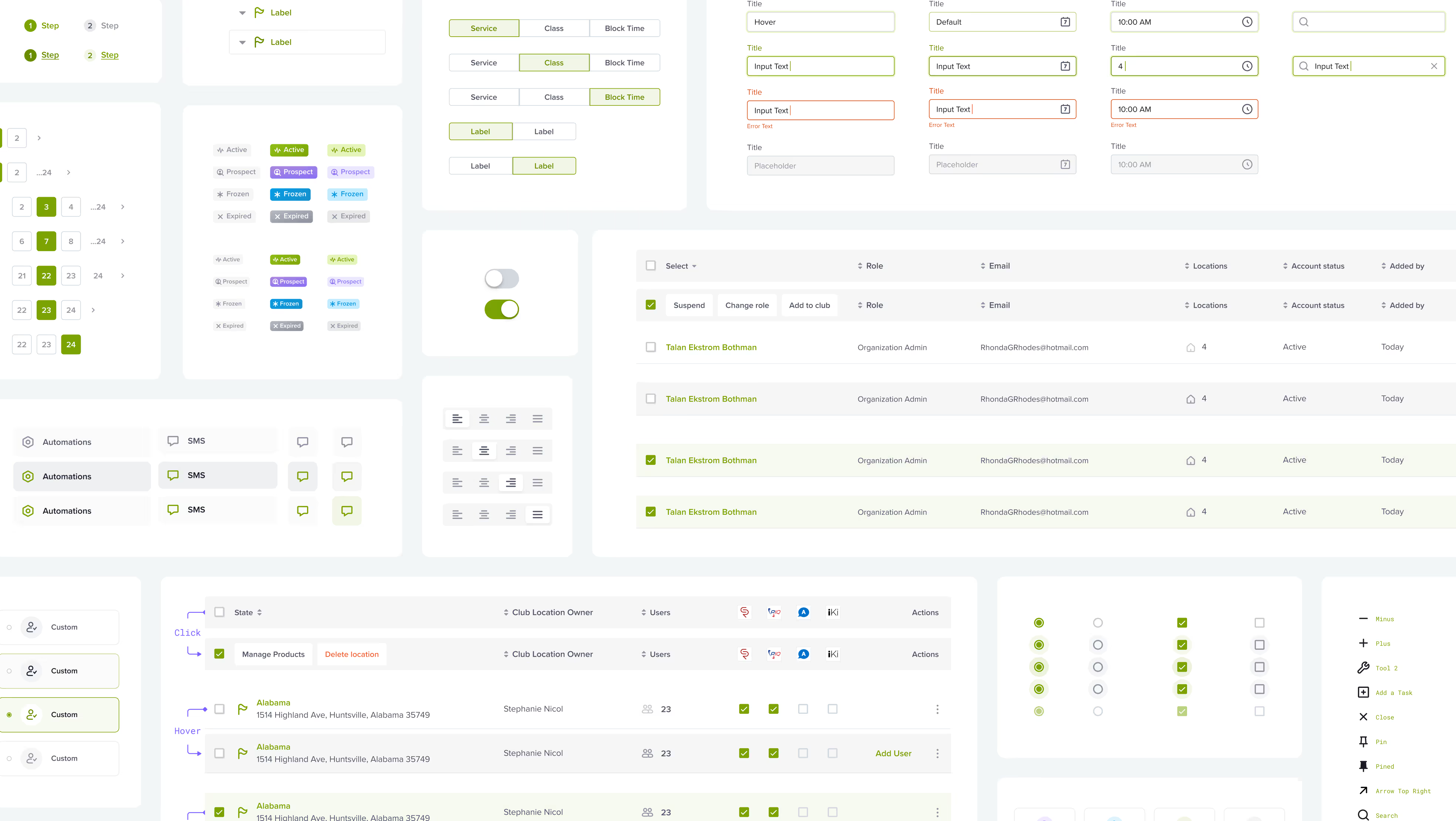
ClubReady is a worked example of the sliced approach. It is a fitness and wellness club management SaaS whose functionality had accumulated over years into separate modules that behaved like unrelated tools, with no shared design language between them. There was no single cutover. The work started with user and market research and a full feature map, then moved module by module over six months: booking and scheduling first, then the marketing suite of conversations, email campaigns and drip campaigns, then task management and communication templates, then user management. Each slice went through usability testing and fed one design system that ended up covering the whole suite, so every module released after the first inherited patterns that were already validated.
What are the challenges in legacy software modernization?
The technical work is rarely the hardest part. These are the issues that derail programmes, and most of them land on the product side.
- Undocumented business logic. Rules that exist only in code, written by people who left. Every rewrite has to rediscover them, and missing one causes a production incident.
- Data quality. Twenty years of workarounds live in the database. Moving legacy data usually exposes problems nobody knew existed.
- Downtime tolerance. Some systems can pause for a weekend. Others cannot pause at all, which forces a parallel-run design and doubles the coordination.
- Change fatigue. Users have adapted to the old interface, workarounds included. A modernized system that ignores their habits gets rejected regardless of how good the architecture is, which is why each slice is worth testing with real users before it reaches everyone.
- Scope creep. Modernization budgets get quietly loaded with new features. Keep the two conversations separate.
- Losing the sponsor. Programmes that run for a year without a visible release burn through the goodwill that funded them. Sequencing a user-visible improvement early is a political decision as much as a design one.
- Vendor lock-in. Replacing one dependency with another proprietary one just moves the problem forward a few years.
How much does it cost to modernize legacy software?
The cost of legacy software modernization depends on seven factors: project scope, system complexity, the technology stack involved, data migration needs, integration requirements, how much of the interface is redesigned rather than carried across unchanged, and the expertise of the team doing the work.
As rough guidance:
- Encapsulating a stable system behind an API is measured in weeks.
- Replatforming or rehosting is usually a one to three month effort per system.
- Redesigning the interface of a module, from research through tested screens, typically runs alongside the engineering work rather than after it.
- Rearchitecting or rebuilding a core product runs six months and up.
Compare modernization costs against the running cost of doing nothing. That number includes licences, hosting, support headcount, incident response, the training time every new hire spends learning a system that should be obvious, and the revenue lost to features you could not ship. Framed that way, most modernization initiatives justify themselves inside two years.
Where does AI fit into application modernization?
AI has changed the economics of modernization work, though not in the way most vendors claim. It does not modernize systems on its own. It removes the slowest manual steps.
Where AI earns its place today:
- Code comprehension. AI tools can summarise unfamiliar legacy code and map dependencies far faster than a human reading files one by one.
- Test generation. Before you refactor anything, you need a safety net. AI can draft characterisation tests against existing behaviour.
- Documentation. Turning undocumented modules into readable specs is exactly the kind of work AI does well.
- Data mapping. Matching old schemas to new ones is tedious and pattern-heavy, which suits AI assistance.
Where AI should not be trusted alone: architectural decisions, anything touching compliance, final code review, and the interface itself. AI is good at producing screens that look plausible and bad at knowing which of the old system's twelve steps existed for a reason. Treat AI output as a fast first draft that a senior engineer or designer verifies.
There is a second reason AI matters here. Most AI features need clean APIs, structured data, and event streams. Legacy systems provide none of those. For a lot of companies, modernization is now the prerequisite for the AI roadmap, not a competing priority. That is also true of any wider digital transformation effort, where the old platform is usually the constraint.
How does Excited approach legacy system modernization?
Excited is a product design agency, and that shapes which half of a modernization programme we own. We start with the user-facing consequences of the old platform, then work backwards into architecture and component design, rather than the other way round. The runtime, data and infrastructure moves sit with your engineering team or your migration partner; our job is to make sure that what people end up using is better than what they had, and that it arrives in slices they can absorb.
Our legacy modernization services cover:
- Modernization assessment. A structured audit of the existing product, its workflows, and the data behind them, ending in a prioritised plan with effort estimates and a recommended sequence.
- UX and interface modernization. Redesigning the interface of a legacy app so the modernized version is genuinely faster to use, not just newer underneath.
- Information architecture and workflow redesign. Re-mapping what the system does, screen by screen, so the new version matches how people actually work rather than how the original database happened to be shaped.
- Design systems built for staged delivery. A documented component library, so every slice your engineers ship inherits patterns that are already validated instead of each module drifting into its own dialect.
- User research and usability testing. Talking to the people who use the old system before anything is designed, then testing each slice before it reaches everyone. This is how change fatigue gets caught while it is still cheap to fix.
- Front-end and marketing site production. Webflow build for the public-facing side of the product, designed and shipped by the same team, alongside our web app design services.
- Working alongside your engineers. We plan the design work around your migration sequence, so interface changes land with the modules they belong to instead of queueing up behind the whole programme.
- Ongoing support. Continued delivery after launch, because a modernization journey does not end at cutover.

Excited has been working this way since 2018. Across eight years the team has delivered more than 100 projects for clients in 20 countries, reached over 15 million users, and collected 30+ international design awards including Red Dot, iF Design, Webby and Awwwards. The modernization work concentrates where platforms accumulate modules faster than they retire them: insurtech, fintech, healthcare, CRM and marketplaces. On InsuredMine, an insurance CRM whose users were switching between disconnected tools to finish a single workflow, we rebuilt the web app, a white-label iOS app and the marketing site onto one 335-component design system between September 2020 and April 2021. On Xilo, an insurance quoting and sales-automation platform, the partnership has run since 2020 and the platform now serves 300+ corporate clients across 38 US states.
{{case-study}}
If you are weighing a legacy modernization project and want a second opinion on the sequence before committing budget, that assessment is where we usually start.
Frequently asked questions
How long does a typical legacy system modernization project take?
It depends on the strategy. Encapsulating a system behind an API can take four to eight weeks. Replatforming usually runs one to three months per system. A full rearchitecture or rebuild of a core product typically takes six to eighteen months, delivered in slices rather than one release.
Can we modernize legacy systems without downtime?
In most cases, yes. The standard approach is to run old and new in parallel, route a small share of traffic to the new system, and increase it as confidence grows. This costs more during the transition, because you pay for both environments, but it removes the risk of a single irreversible cutover.
Should we rewrite or refactor our legacy application?
Refactor when the business logic is sound and the problem is structure. Rewrite when the code is unsafe to change, the platform is unsupported, and the requirements are well understood. If you cannot describe what the current system does in detail, you are not ready to rewrite it.
Should we redesign the interface before, during, or after the technical migration?
During, slice by slice, in most cases. Redesigning everything first produces a design nobody can build, against a system that is still moving underneath it. Leaving it until after means shipping a modernized platform with the old interface bolted on top, which is how a programme hits every technical goal and still gets judged a failure by the people using it. The workable pattern is to redesign each module as it is migrated, so users see a visible improvement with every release and the design system grows alongside the new architecture.
Who should own a legacy modernization programme, IT or product?
Both, with different halves. IT owns the runtime, data and infrastructure sequence, and the plan for switching the old system off. Product owns which modules get modernized first, what each release is supposed to change for the people using it, and the baseline numbers the programme will be judged against. Programmes run entirely out of IT tend to land on time and still get rated a failure by users; programmes run entirely out of product tend to underestimate the migration and stall halfway. The practical split is that IT decides what is technically possible in what order, and product decides which of those orders is worth paying for.
Will a modernized system support AI and other future technologies?
That is largely the point. Clean APIs, structured data, and modern infrastructure are what AI, analytics, and automation tools need to connect to. A system that cannot expose its data cannot participate in any of them, regardless of how well it performs its original job.
How do we choose a legacy modernization company?
Match the partner to the part of the problem that is actually blocking you. If the constraint is runtime, data, or infrastructure, you want an engineering partner who can show comparable migrations and who talks about decommissioning the old system rather than only building the new one. If the constraint is that people cannot use the system — onboarding takes weeks, adoption stalls, demos lose deals — you want a product design partner, and the questions are different: will they talk to your users before proposing an architecture, can they show a modernized product in use rather than a migration plan, and do they bring a design system your engineers can ship against in slices? Most serious programmes need both. The expensive mistake is assuming one supplier covers the other's half.
Conclusion
The decision that matters in legacy system modernization is not which technology to adopt. It is which parts of the system to change, in what order, and whether the people using it will be able to tell. Take the baseline before you start, assess honestly, pick a strategy per system, ship in slices, redesign the interface as each slice moves rather than after all of them, and switch the old one off. Everything else is detail.
ClubReady, a leading fitness SaaS provider, partnered with our design team on a component-driven redesign of a dense operations product.
Service short description
Frequently Asked Questions
Sources
What Is Legacy Application Modernization?
About the migration strategies
Use the 7 Rs to develop an app modernization strategy
Reinventing tech finance: The evolution from IT budgets to technology investments
Information Technology: Agencies Need to Plan for Modernizing Critical Decades-Old Legacy Systems
Reducing UX Debt: A Guide to Identifying and Resolving Issues
ERP Software UX: Designing Your Enterprise System
How We Design Complex Web App UX That Engineers Can Actually Build